SHAOXING, ZHEJIANG, CHINA, October 12, 2026 /EINPresswire.com/ —
Zhejiang Guanfeng Food Machinery Co., Ltd. serves the food processing industry with machinery designed to support preservation, drying, and freezing applications. As food producers seek to extend shelf life, maintain product quality, and improve production efficiency, vacuum freeze drying has become an important technology for selected food categories. Alongside its freeze-drying equipment, the company offers complementary solutions, including IQF Freezer and Belt Dryer systems, for different processing requirements. Its product portfolio reflects the growing need for flexible machinery that can accommodate diverse ingredients and production targets.
The Growing Demand for Vacuum Freeze Drying
Food preservation is essential for manufacturers supplying domestic and international markets. Fruits, vegetables, seafood, meat, and prepared foods can deteriorate because of moisture, temperature fluctuations, and microbial activity. Choosing an appropriate preservation method helps processors manage these risks while maintaining the qualities expected by consumers.
Vacuum freeze drying, also known as lyophilization, removes moisture from frozen products under reduced pressure. During primary drying, ice changes directly into water vapor through sublimation. Secondary drying then removes additional moisture to achieve the required final condition.
Because the process operates at relatively low product temperatures during primary drying, it can help preserve the shape, color, aroma, and flavor of many ingredients. The porous structure of freeze-dried products can also support rehydration. These characteristics make the technology suitable for applications such as fruit snacks, herbs, instant beverages, specialty ingredients, and selected prepared foods.
However, freeze drying requires careful control of temperature, pressure, freezing conditions, and drying time. Different ingredients respond differently to processing, so manufacturers must establish suitable operating parameters for each product. Equipment selection should therefore consider more than nominal capacity: chamber dimensions, refrigeration performance, vacuum capability, condenser capacity, and energy consumption can all affect production.
Zhejiang Guanfeng Food Machinery Co., Ltd. participates in this market by supplying food processing machinery for different preservation needs. Its wider range allows buyers to consider freeze drying alongside other technologies, depending on the products they manufacture and the results they require.
Zhejiang Guanfeng Food Machinery Co., Ltd. and Its Product Portfolio
Zhejiang Guanfeng Food Machinery Co., Ltd. specializes in food processing equipment, including vacuum freeze dryers, freezing systems, continuous drying machinery, and related equipment. Its portfolio also covers pretreatment machinery and other solutions used in food production lines.
This range reflects the interconnected nature of commercial food processing. Before preservation, ingredients may require washing, sorting, cutting, or blanching. After processing, products may need packaging, storage, and distribution under controlled conditions. Choosing equipment that fits the complete production process can help manufacturers avoid bottlenecks and improve operational coordination.
For international buyers, practical factors are also important. Equipment capacity, factory space, utility requirements, installation arrangements, operator training, and maintenance access all influence purchasing decisions. Buyers should confirm technical specifications and applicable documentation before committing to a machine.
The company’s product range includes IQF Freezer and Belt Dryer systems, which serve different purposes from vacuum freeze drying. Understanding these differences helps food manufacturers choose a process that matches their products, target quality, and operating budget.
Vacuum Freeze Dryers and Product Quality
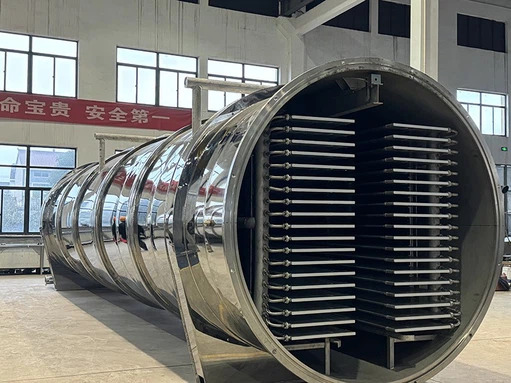
A commercial vacuum freeze dryer typically consists of a drying chamber, refrigeration system, heating arrangement, vacuum pumps, condenser, product trays, and control system. These components work together to freeze the product, maintain reduced pressure, and remove moisture under controlled conditions.
The process begins by freezing the material. Once the chamber reaches the required vacuum level, carefully controlled heat provides the energy needed for sublimation. Water vapor moves toward the condenser, where it is captured as ice. Secondary drying then removes additional moisture from the product.
Process control is essential. Excessive heating during primary drying can damage product structure, while insufficient drying may leave residual moisture that affects storage stability. Cycle time also matters because longer processing can reduce daily output and increase operating costs.
Different ingredients require different treatment. Fruit with high sugar content, herbs containing delicate aromatic compounds, seafood, and prepared meals may have different freezing and drying characteristics. Manufacturers should therefore assess the suitability of the equipment for the specific product rather than assuming that one processing cycle will work for every ingredient.
When evaluating a vacuum freeze dryer, buyers should consider batch capacity, drying-cycle duration, freezing performance, vacuum stability, condenser capacity, loading arrangements, cleaning requirements, and energy use. They should also evaluate how the machine connects to upstream preparation and downstream packaging.
Zhejiang Guanfeng Food Machinery Co., Ltd. provides vacuum freeze-drying equipment for food processing applications. For prospective customers, discussions about raw materials, expected output, final moisture requirements, and available factory utilities can help establish a suitable configuration.
IQF Freezer: Efficient Individual Quick Freezing
Individual quick freezing, commonly known as IQF, is used to freeze food pieces separately rather than in a single solid block. It is widely applied to products such as berries, diced vegetables, peas, corn, seafood, and other ingredients that benefit from remaining easy to portion after freezing.
Depending on the design, an IQF system may use fluidized-bed, tunnel, or other freezing configurations. The appropriate system depends on the size, shape, moisture content, and initial temperature of the product, as well as the required throughput and final temperature.
Freezing rate influences ice-crystal formation and the resulting product structure. Under suitable conditions, rapid freezing can help limit damage caused by larger ice crystals. Nevertheless, product quality also depends on raw material condition, pretreatment, process settings, and cold-chain management.
Zhejiang Guanfeng Food Machinery Co., Ltd. includes IQF Freezer equipment in its product portfolio. These systems are relevant to processors seeking to freeze individual pieces of fruit, vegetables, seafood, and other suitable foods.
When selecting an IQF Freezer, manufacturers should examine hourly capacity, entry and exit temperatures, belt configuration, freezing duration, refrigeration requirements, cleaning access, and energy consumption. Products of different sizes or moisture levels may require adjustments to achieve consistent results.
An IQF freezer also forms part of a larger food safety system. Appropriate hygiene, temperature monitoring, packaging, and frozen storage remain essential. Maintaining the required temperature during transport and distribution helps protect quality after the product leaves the processing line.
For food producers handling seasonal ingredients, IQF technology can help make products available beyond the harvest period. It can also support portion control and more predictable ingredient supply for food service and industrial manufacturing.
Belt Dryer: Continuous Dehydration for Food Production
A Belt Dryer removes moisture by conveying products through a controlled drying environment. Heated air passes around or through the material as it moves along the belt, allowing moisture to evaporate during the process. Depending on the configuration, the dryer may use multiple stages with different temperature and airflow conditions.
Belt drying can be suitable for products such as sliced vegetables, fruit pieces, herbs, and other materials that can tolerate the required drying conditions. Compared with batch drying, a continuous system can help maintain a steady flow of material in factories with consistent production demand.
Performance depends on product thickness, moisture content, loading depth, airflow distribution, conveyor speed, and air temperature. Uneven loading or poor airflow can lead to inconsistent moisture levels, while excessive heat may affect color, flavor, and texture. Manufacturers must establish appropriate operating parameters for each ingredient.
Zhejiang Guanfeng Food Machinery Co., Ltd. offers Belt Dryer equipment for continuous food processing. Buyers considering this technology should evaluate throughput, target moisture content, heating method, energy consumption, conveyor design, cleaning procedures, and maintenance requirements.
The choice between belt drying and freeze drying depends largely on the desired final product. Freeze drying is often selected when preservation of structure and rehydration characteristics is a priority. Belt drying may be more appropriate for products that can tolerate conventional heat-based dehydration and require continuous processing at scale.
Some food manufacturers use several preservation methods across their product ranges. Choosing the appropriate equipment for each product can help balance quality, processing time, operating costs, and market expectations.
Choosing the Right Processing Equipment
Selecting food preservation machinery starts with a clear understanding of the product and production goals. Manufacturers should define raw material characteristics, required output, final moisture or temperature, packaging format, and storage conditions before comparing equipment.
For vacuum freeze drying, important considerations include batch size, cycle time, vacuum performance, and sensitivity to heat. For IQF freezing, product dimensions, throughput, freezing capacity, and cold-chain requirements deserve attention. For belt drying, moisture removal targets, airflow, temperature, and continuous production needs are central to the evaluation.
Buyers should also consider installation space, power supply, available heating and cooling utilities, and the layout of the existing factory. A machine with a high stated capacity may not deliver the expected production rate if upstream preparation or downstream packaging cannot keep pace.
Where possible, product trials can help verify process conditions and final quality. Manufacturers should request technical specifications, operating instructions, maintenance schedules, and relevant certificates or test documentation. They should confirm the scope and validity of any certification required for their intended market.
Quality Control and After-Sales Considerations
Food machinery must operate reliably while meeting appropriate hygiene and safety requirements. Food-contact surfaces, conveyors, trays, seals, and handling areas should be suitable for the intended product and cleaning process. Regular inspection and preventive maintenance can help reduce downtime and support consistent production.
Maintenance planning may include checking refrigeration components, vacuum pumps, seals, motors, sensors, conveyors, and other parts relevant to the equipment. Access to replacement parts and technical guidance can be particularly important for factories with seasonal workloads or continuous production schedules.
Automation can help operators monitor key process parameters, but its effectiveness depends on suitable process design and staff training. Clear operating procedures help maintain consistent results between batches and shifts.
For customers considering machinery from Zhejiang Guanfeng Food Machinery Co., Ltd., communicating the product type, required capacity, factory conditions, and intended processing method can help clarify equipment needs before purchase. Buyers should also discuss installation, commissioning, training, and technical support arrangements as part of the procurement process.
Conclusion
Vacuum freeze drying, individual quick freezing, and belt drying each provide distinct approaches to food preservation. Freeze drying is suited to products where low-temperature moisture removal and rehydration characteristics are important. IQF technology supports the freezing of individual food pieces, while belt drying provides continuous dehydration for suitable ingredients.
Zhejiang Guanfeng Food Machinery Co., Ltd. offers equipment across these processing categories, including IQF Freezer and Belt Dryer systems. For manufacturers evaluating a vacuum freeze dryer, the most effective approach is to match machinery to product characteristics, output requirements, quality objectives, energy use, and the wider production workflow.
As food producers continue to diversify their product ranges and improve processing efficiency, choosing suitable preservation technology remains central to building reliable production lines.
About Zhejiang Guanfeng Food Machinery Co., Ltd.
Zhejiang Guanfeng Food Machinery Co., Ltd. is a Chinese manufacturer specializing in food processing and preservation equipment. Its product portfolio includes vacuum freeze dryers, IQF Freezer systems, Belt Dryer equipment, tunnel and spiral freezers, pretreatment machinery, and related solutions. The company serves food processing applications involving fruits, vegetables, seafood, meat, and other products. For more information about its equipment and manufacturing services, visit www.guanfengmachine.com.
Address: South Industrial Park of Dongguan,
Shangyu District, Shaoxing City,
Zhejiang Province,China
Official Website: https://www.guanfengmachine.com/
Shelly
Zhejiang Guanfeng Food Machinery Co., Ltd.
export@syguanfeng.com
Legal Disclaimer:
EIN Presswire provides this news content “as is” without warranty of any kind. We do not accept any responsibility or liability
for the accuracy, content, images, videos, licenses, completeness, legality, or reliability of the information contained in this
article. If you have any complaints or copyright issues related to this article, kindly contact the author above.

Media gallery