Morristown, New Jersey May 7, 2026 (Issuewire.com) The Digital Millennium Copyright Act (DMCA), enacted in 1998, allows copyright holders to request removal of content from Google Search. URLs can be deindexed before a claim is independently verified, and reinstatement may take several weeks. In March 2026, business owners and publishers from several countries noticed that their websites were targets of mass DMCA complaint abuse. What happened and why it is not new is discussed further.
A Recurring Issue Across Business Sizes
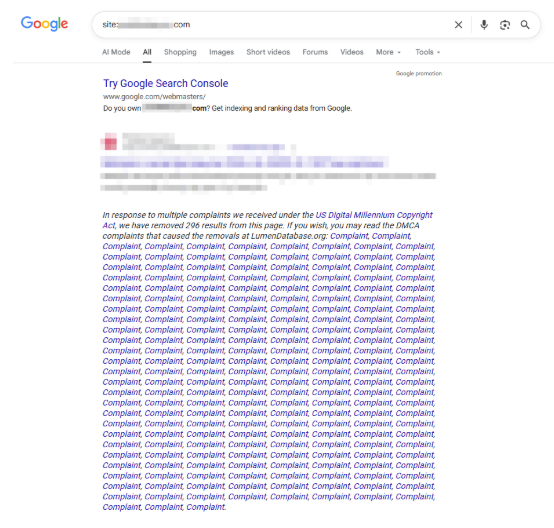
High-volume DMCA complaints have been filed against businesses and publishers of all sizes. The most recent case to receive widespread coverage involved Press Gazette, which published an investigation into SEO firm Clickout Media on 25 March 2026. Within days, the article was removed from Google’s search index. A notice visible in the search results read: “In response to multiple complaints that we received under the US Digital Millennium Copyright Act, we have removed 2 results from this page.” The complaints cited a 2024 Verge article as the allegedly infringed source though The Verge was not listed as the complainant. A follow-up piece by Search Engine Land covering the same story was removed shortly after via a similar complaint.
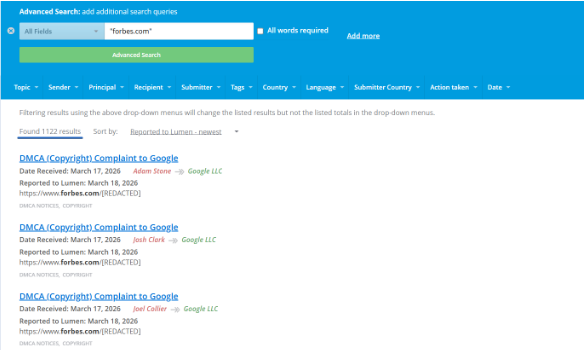
Media organisations are not exempt from this pattern including those with the scale and editorial standards that make copyright infringement an unlikely concern. Forbes, one of the most recognised business media brands globally, has also been among the recipients of high volumes of DMCA complaints. The same has been true for other established publishers across multiple years.
Forbes.com has received over a 1000 complains.
While researching for this article, we also came across a website that had significant organic traffic. It fell victim to mass DMCA complaints and was removed almost entirely from search results the only page left indexed was the homepage. After a thorough review, we found no copied content on the website; all published material appeared to be entirely original. This case is another documented example of how unverified DMCA complaints can be used to remove legitimate content from Google Search results.
One earlier case that drew attention was the 2022 deindexing of Moz.com, a widely known SEO industry resource. Its homepage was removed from Google following a DMCA complaint and reinstated within a day. The case confirmed that the issue is not recent and that it affects recognised names in the industry, not only obscure websites.
Beyond high-profile cases, thousands of smaller businesses have reported the same experience.
Where an organisation like Forbes or Moz has the legal resources, platform contacts, and public visibility to resolve the matter quickly, smaller operators often do not. Many are unaware of the counter-notification process, or find it difficult to navigate without legal guidance.
This reality is reflected in public forums: Reddit’s r/ModSupport contains multiple threads from site owners describing coordinated DMCA complaint patterns, with one moderator noting “a clear pattern of abusive reports from a single source” targeting their platform.
The Google Webmasters community support thread documents similar accounts, including one site owner who wrote: “I am forced to disclose real data in order to get back into Google Search, but I’m receiving no data about the sender the DMCA notice points to a name which has no match.”
How DMCA Notices Are Used Beyond Their Original Scope
The DMCA’s notice-and-takedown framework is built for speed: platforms are expected to act on a submitted notice before independently verifying the claim. At current volumes, the majority of requests are processed algorithmically which means that by the time any manual review occurs, the content is already gone.
This creates a practical opening that has been documented in several ways. Patent attorney Bao Tran of PatentPC identified three recurring patterns: filing removal requests against a competitor’s content to reduce its search visibility; submitting notices in bulk through automated systems before review can take place; and timing submissions to coincide with product launches or publication dates, maximising the window during which content remains inaccessible.
These are not theoretical scenarios. In a lawsuit filed by Google against two individuals Nguyen and Pham the company alleged that the defendants created over 65 accounts and submitted hundreds of thousands of removal requests targeting competitor websites, with approximately 117,000 URLs directly affected.
On a different scale, investigative reporting by Forbidden Stories and Rest of World documented Eliminalia, a Spanish firm that allegedly created backdated copies of articles and used them as the basis for DMCA complaints so that the original article appeared to be the infringing one and was deindexed as a result. OCCRP reported a similar experience, with at least one of its articles removed following a complaint the organisation described as fabricated.
What makes the situation harder to resolve is a built-in asymmetry in the counter-notification process. A site owner seeking reinstatement must submit personal contact information, which is then forwarded to the complainant. The complainant, however, is under no equivalent obligation to identify themselves.
Scale and Proposed Improvements
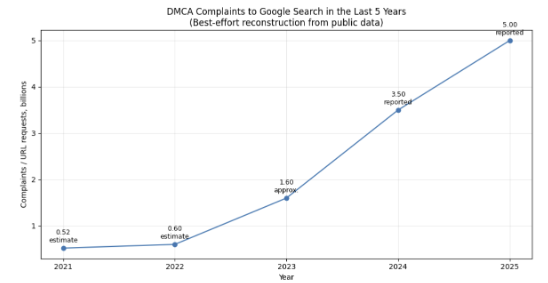
The numbers reflect how significantly the system has grown. According to TorrentFreak’s December 2025 report, Google processed over five billion copyright removal requests in 2025 removing more than 2.7 billion URLs at a rate of close to 10,000 per minute. In 2010, the annual total was approximately 250,000. The Lumen Database, which archives notices across Google, YouTube, Reddit, and GitHub, now receives more than 20,000 new entries per week.
The increase of DMCA complains to Google Serac over 5-year period.
Automation drives much of this volume and the same tools available to legitimate rights holders are accessible to anyone. With AI capable of generating complaint text and identifying target URLs at scale, notice volumes are likely to increase further.
Proposed responses include requiring verifiable proof of ownership before a notice is processed, introducing submission rate limits, creating faster counter-notification pathways, and requiring complainant identity to be disclosed to affected site owners. These proposals have been discussed in legal and policy forums for several years.
Why This Conversation Matters
For any business that relies on Google Search (and most do) being deindexed is not a technical inconvenience. It means reduced traffic, fewer customers, and in some cases a direct loss of revenue, for as long as the process takes to resolve.
The DMCA counter-notification procedure exists, but it requires time, some degree of legal literacy, and the willingness to submit personal information to an anonymous complainant. For small businesses operating without legal support, that is not always a realistic option. As long as submitting a complaint remains faster and simpler than contesting one, the imbalance remains.
Raising awareness of the issue: how it works, who it affects, and what procedural changes have been proposed, is a practical step toward reducing the number of businesses that encounter it without knowing what it is or what they can do about it.
Sources and Further Reading
- Dominic Ponsford, Press Gazette (March 30, 2026): Press Gazette exposé of parasite SEO firm removed from Google results
- Danny Goodwin,Search Engine Land (March 30, 2026): Google removes Search Engine Land article after false DMCA claim
- Bao Tran, PatentPC (March 16, 2026): Common Tactics Used in DMCA Abuse and How to Combat Them
- Community thread on DMCA report patterns: Reddit r/ModSupport
- Google Webmasters community thread on mass DMCA complaints: Google Search Central Help
- TorrentFreak (December 2025): A DMCA “Bot War”: Google Search Processed 5 Billion Takedown Requests in 2025
- OCCRP / Medium: Fighting the Fakers: A Guide to Dealing With Bogus Copyright Complaints on Google
- Forbidden Stories (February 2023): The Gravediggers: How Eliminalia, a Spanish reputation management firm, buries the truth
- Rest of World (2022): Exposed documents reveal how the powerful clean up their digital past using a reputation laundering firm
- Electronic Frontier Foundation: DMCA Issues and Takedown Abuse
- Lumen Database, Harvard Berkman Klein Center for Internet & Society: lumendatabase.org
Source :Google
This article was originally published by IssueWire. Read the original article here.