FAYETTEVILLE, AR / ACCESS Newswire / April 13, 2026 / Preserving one of the few remaining mid-century modern structures on a prominent college campus, MBL Architecture (MBL) is proud to announce the completion of work at University of Arkansas’ renowned Fine Arts Center.
Originally designed in 1951 by acclaimed architect Edward Durell Stone, the university’s School of Art will officially reopen April 16 with a renewed interconnectivity of the arts and campus and tribute to the historic modernist architecture and landscape design. The endeavor was a partnership between MBL and TenBerke.
“We are honored to collaborate with the University of Arkansas and TenBerke on such an important project in the heart of campus,” said Roger Boskus, president of MBL, a national design firm headquartered in Fayetteville. “The School of Art’s vision for the Fine Arts Center advances the arts and sustains the legacy of Edward Durell Stone.”
Stone’s design divides the facility into three functional blocks consisting of the concert hall, classroom wing, and theatre – all tied together by a transparent lobby/gallery connecting space. For the restoration, the design team preserved the integrity of the design vision by reestablishing the interconnectedness of the spaces.
The lobby/gallery was restored to its original flexible open layout as a place to gather, impromptu performances, and collaborate. Existing storefront window frames were restored while windows from previous renovations were removed and replaced to regain the original view to the newly refurbished courtyard. The three-story classroom wing operable windows were restored to their original condition to preserve the visual connection to the rest of the campus.
“Having grown up around the Fine Arts Center, it has been a privilege to work with the University of Arkansas to enhance the arts program and continue the modernist legacy of Edward Durell Stone,” said Steven Jones AIA, LEED AP at MBL. “The cross-disciplinary aspect of the School of Art is important to maintain and inspire future artists.”
Passing students can see the internal workings of the art department while office and classroom space is flooded with natural light. Through extensive research and onsite investigations, the design team determined that the original frames were painted turquoise green, and they reintroduced color to enliven the architecture and provide a clear identity for the School of Art.
The restoration revisits a lesser-known chapter of American art history, when works by legends – including Pablo Picasso, Edward Hopper, Marc Chagall, Georges Braque and others – were exhibited in a region largely absent from dominant narratives of modernism.
“To work within a historically significant building is to inherit a story,” said MBL architect Chris Fowler, AIA. “Our role is not to rewrite it, but to extend it by carefully and thoughtfully breathing new life into its walls so it may continue to serve with purpose and relevance.”
Along with the restoration of the exterior windows, the exterior preservation included cleaning and repair of the existing brick veneer. MBL meticulously researched a suitable brick to blend seamlessly with the historical masonry to replace damaged ones and rebuild the site screen walls surrounding the sculpture garden on the west side of the lobby. This integration of the landscape with the architecture allows for exterior programming and creates community within the shared garden space. During the work on the sculptural garden, the fish in the existing koi pond were carefully removed during construction until they could return to their newly restored home. Ground Control, a national landscape and urban design firm, served as the landscape architect for the project.
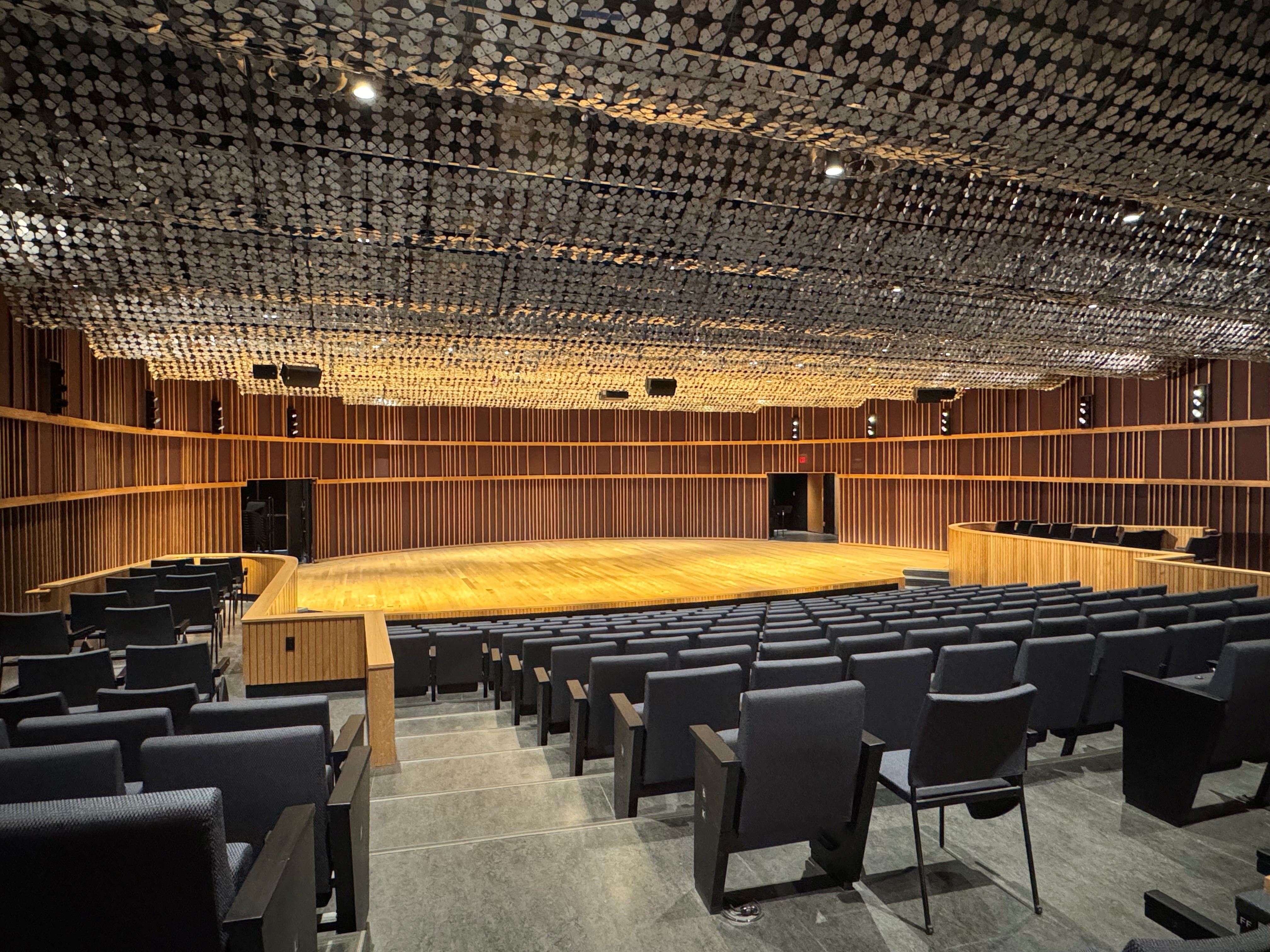
The Concert Hall renovation required the design team to upgrade the 1951 space to contemporary performance venue. The stage was extended to make the performance space deeper, sight lines were adjusted with new seating for better audience connection, and appropriate theatrical stage lighting was installed. In collaboration with theatrical and acoustical consultants, a new electronic-acoustic enhancement system enables the hall to expand the acoustic range within the limitations of the space. To accommodate the Concert Hall upgrades, MBL performed a structural analysis of the existing structure and compensated for the lighting and speakers with additional integrated structure.
To increase the concert hall functionality and lack of space for performances, rehearsals, and lectures, a transparent back-of-house addition was added on the north side for dressing room and storage space. Accentuating the addition, an undulating sculptural wood finish in the corridor is visible through the glass wall along one of the primary paths to the student union to the west and the main library toward the east.
“The Fine Arts Center was conceived as a place where the arts could converge under one roof, and that exchange remains central to how we educate today,” said Rachel Debuque, director of the School of Art. “Our students and faculty collaborate across disciplines – from public art mural projects and research in the Arkansas prairies to immersive technologies developed with colleagues in the sciences. In this way, the School of Art advances the Fine Arts Center’s vision: that the arts enrich academic journeys and strengthen Arkansas’ cultural life.”
The Fine Arts Library was expanded to double its original size. A two-story space with the original wood railing and wood stair down to the basement is central to the design. Continuing with modern design principals, the south wall was opened toward the lobby for a direct visual connection between the spaces. Lighting, shelving, and furnishings were upgraded to meet today’s university standards while meeting Stone’s design intent.
MBL and the design team emphasized the modernist use of honest, human-scaled materials throughout. Defining architectural features such as the metal mesh ceiling in the concert hall and windows in the classroom wing were preserved while inserting contemporary elements for today’s educational needs. The warmth of wood envelops the concert hall with vertical slats that help with acoustics and hide lighting and speakers. Oak framing also surrounds the interior entries and is carried through from the original construction as a gridded ceiling element in the offices. Acknowledging the original vision, the corridors are constructed of warm tone, burnished concrete block for durability in a working collegiate art space.
“This has been a thrilling collaboration to help re-establish this visionary building as a welcoming and creative crossroads on campus,” said Noah Biklen, senior principal, TenBerke. “We are looking forward to all the teaching, research, and creativity that the transformed Fine Arts Center will inspire over its next 75 years.”
Building features include:
-
Acoustical control between spaces was a high priority. The concert hall was acoustically isolated from the addition and lobby spaces by a high STC-rated wall assembly. The roof and exterior walls include additional acoustical insulation to keep sound from the adjacent road and bus station from interrupting performances.
-
Doubled the size of the Fine Arts Library.
-
Reinstallation of the originally commissioned Alexander Calder sculptures.
-
Added graduate student offices to classroom wing to allow the School of Art to expand its graduate program.
-
Upgraded elevator to make it easier for users to access the new restrooms in the existing basement and lower level of the library.
-
Restored original open stair and railing from lobby to basement.
-
Previous additions to north entry removed to allow a more inviting access point from the center of campus.
-
Restored the original Christopher Tunnard-designed landscape including the sculpture garden, lawn, rectangular pool, and the masonry screen walls. Sycamore trees and pin oaks were preserved from the original design.
ABOUT MBL
MBL Architecture is located in Fayetteville, Ark.; Vista, Calif.; and Santa Rosa Beach, Fla. Our cross-disciplinary team includes architects, urban designers, city officials, interior designers, mixed-use development experts, and LEED accredited professionals, as well as partners with experience in zoning/ordinance writing, civil engineering, economic development, grant writing, public engagement, and plan implementation. We are committed to working with clients to prepare plans that are tailor-made to any budget or level of complexity. For more information, visit mbl-arch.com.
Media Contacts:
Andrew King
aking@hoytorg.com
914-513-6895
Kelly Reynolds
kreynolds@hoytorg.com
310-343-3197
SOURCE: MBL Architecture
View the original press release on ACCESS Newswire