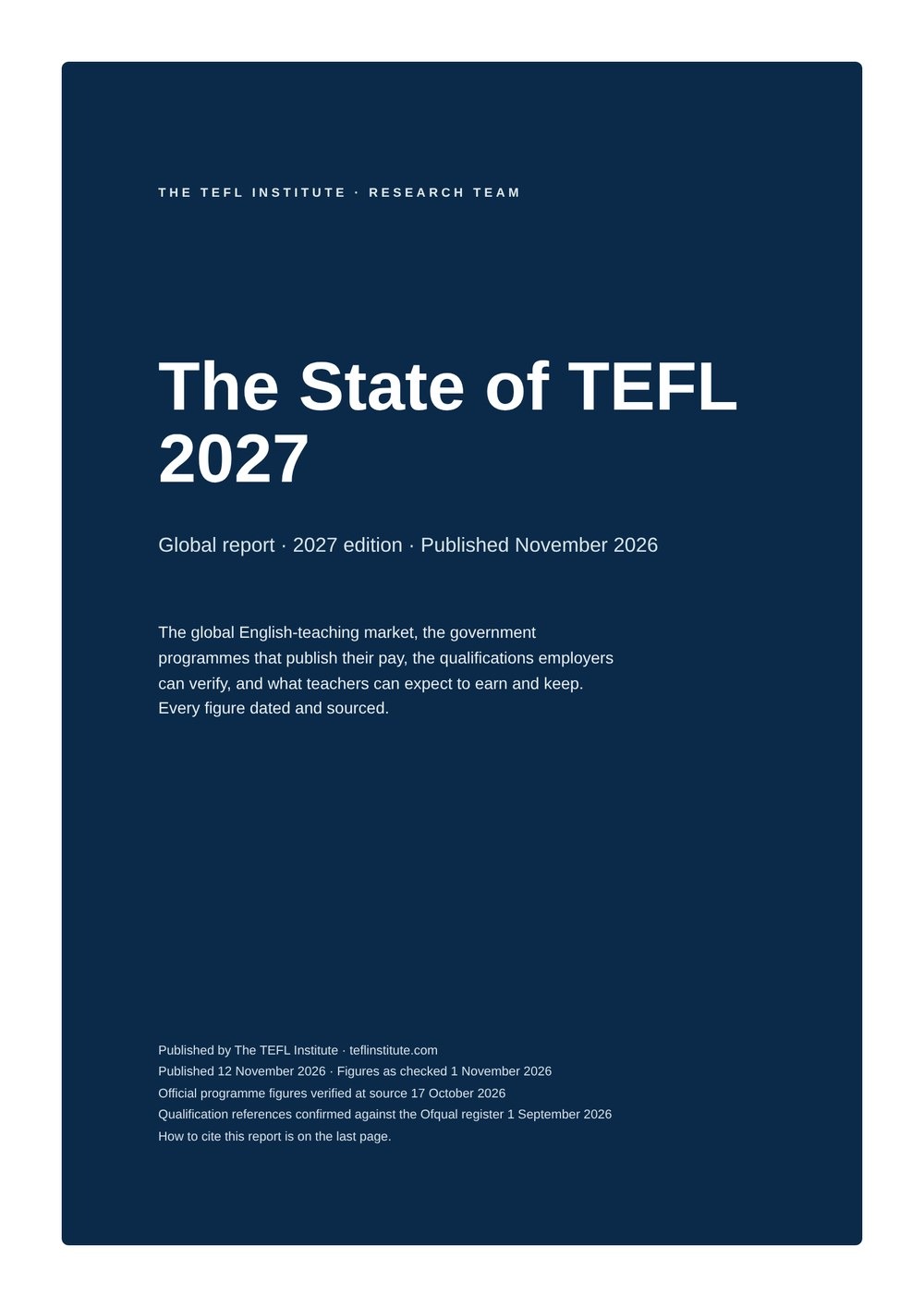
A free 30-page report separates official teacher pay from market estimates and explains which TEFL qualifications employers can verify.
DUNGARVAN, IRELAND, November 19, 2026 /EINPresswire.com/ — Much of the pay information circulating in the English teaching world is guesswork presented as fact. The TEFL Institute today published The State of TEFL 2027, a free 30-page report that does something the industry has rarely done: it separates the few salaries governments have actually published from the market estimates that fill the rest of the internet.
The headline finding is stark. Only four government programmes publish a teaching salary: Japan’s JET Programme, South Korea’s EPIK, France’s TAPIF and Spain’s NALCAP. Almost every other pay figure a prospective teacher sees, for the Gulf, Southeast Asia, Europe or Latin America, is an estimate drawn from job listings or compiled by third parties. The report keeps the two apart and labels each figure accordingly.
The official scales vary widely. JET pays ¥4.02 million in year one, about US$2,120 a month, but does not provide housing. EPIK pays 2.2 to 2.8 million won a month on its main scale, roughly US$1,650 to US$2,100, and includes a furnished apartment, severance and airfare, which can change how much a teacher actually keeps. TAPIF pays €1,010.67 a month gross for up to 12 hours a week, and NALCAP pays €800 to €1,000 a month for 14 to 16 hours a week. The report is clear that TAPIF and NALCAP are part-time stipends, not living wages. All four figures were read on each programme’s own website on 17 October 2026, with dollar conversions at European Central Bank rates from 16 October 2026.
For everywhere else, the report presents estimates and says so plainly. Job-listing estimates put the Gulf at US$2,200 to US$5,500 a month tax-free, East Asia at roughly US$1,200 to US$3,000, Southeast Asia at US$1,000 to US$2,000, Europe at €800 to €2,200 and Latin America at US$800 to US$1,100. Those ranges were compiled in March 2026 and have not been re-verified, and the report marks them that way wherever they appear.
Market size gets the same scrutiny. Market.us values the global English language training market at US$89.5 billion in 2024 and forecasts US$181.1 billion by 2034, with Asia-Pacific holding 42 percent of the 2024 total. The British Council estimates that 1.5 billion people are learning English worldwide. Other research houses define the market differently and reach very different totals. The report explains those differences rather than picking the most flattering number.
The qualifications section answers a question many career changers ask: how does an employer check a TEFL certificate? Courses listed on the Ofqual Register of Regulated Qualifications carry a reference number that anyone can search, along with guided learning hours and the awarding body. A course with no regulator behind it can only be verified on the provider’s word. The report uses two Level 5 TEFL diplomas as worked examples, both awarded by Highfield Qualifications, and states that the register entries were checked by hand on 1 September 2026.
The report also covers English proficiency, study travel, visa routes by destination, salaries against cost of living, and the role of artificial intelligence in the classroom. On AI, it finds that the technology is changing how English teachers work rather than removing the need for them. It cites a 2025 ScienceDirect study which found that combining ChatGPT with teacher feedback improved EFL learners’ argumentative writing, and that the teacher’s feedback made the difference.
“Teachers make major decisions based on the numbers they find online, and too many of those numbers have no source,” said Ian O’Sullivan, at The TEFL Institute. “We wanted one report where every figure has a source and a date. Where we could not trace a number, we removed it. The report also includes a corrections ledger listing what our March edition got wrong, because research is only worth trusting if it admits its own errors.”
Ian O’Sullivan added: “Our advice to anyone considering teaching abroad is to check the official programme page before applying, verify any qualification on the regulator’s register, and confirm important details with official sources before making a decision. The report shows exactly where to do each of those things.”
The State of TEFL 2027 is available now as a free PDF, with no email required, at https://teflinstitute.com/teflinstitute-com-research-state-of-tefl-2027/
About The TEFL Institute: The TEFL Institute is a Highfield Qualifications Approved Centre and part of The TEFL Institute Group. Its research is produced under a published editorial charter and reviewed through the DEAC/AQC quality assurance framework.
Media contact: The TEFL Institute, +44 20 3318 5366, hello@teflinstitute.com
Olivia Klimczyk
The TEFL Institute
+ +353 86 080 5385
Visit us on social media:
LinkedIn
Instagram
Facebook
YouTube
TikTok
Legal Disclaimer:
EIN Presswire provides this news content “as is” without warranty of any kind. We do not accept any responsibility or liability
for the accuracy, content, images, videos, licenses, completeness, legality, or reliability of the information contained in this
article. If you have any complaints or copyright issues related to this article, kindly contact the author above.

Media gallery