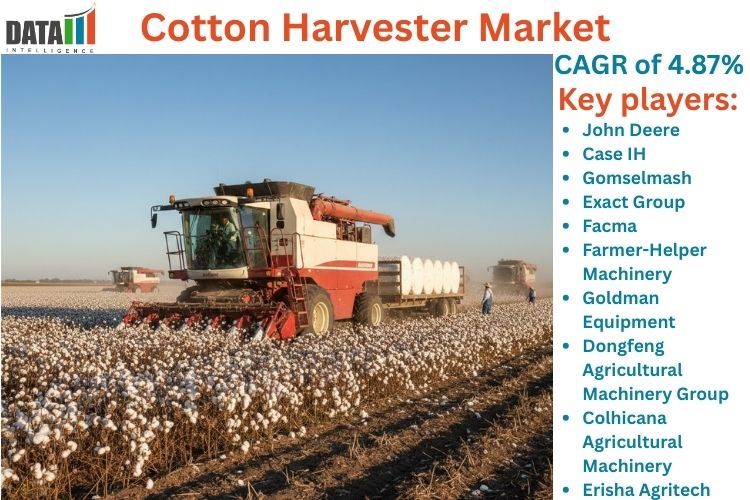
The Cotton Harvester Market is estimated to reach at a CAGR of 4.87% during the forecast period (2024-2031).
AUSTIN, TX, UNITED STATES, February 20, 2026 /EINPresswire.com/ — Market Overview:
The Global Cotton Harvester Market is witnessing steady growth, driven by rising mechanization in agriculture, increasing labor shortages, and the need to enhance productivity in cotton farming. Cotton harvesters are specialized agricultural machines designed to efficiently collect cotton from fields with minimal crop damage and maximum yield recovery. As cotton remains a critical raw material for the textile and apparel industries, the demand for advanced harvesting equipment has grown significantly across major cotton-producing regions.
To Download Sample Report Here: https://www.datamintelligence.com/download-sample/cotton-harvester-market
Market growth is primarily fueled by the expansion of commercial cotton farming, technological advancements such as GPS-enabled and AI-integrated harvesters, and government support programs promoting farm mechanization. The self-propelled cotton harvester segment leads the market due to its higher efficiency, reduced labor dependency, and ability to operate on large-scale farms. Geographically, North America dominates the cotton harvester market, supported by large farm holdings, high adoption of precision agriculture technologies, and the presence of leading agricultural machinery manufacturers. However, Asia-Pacific is emerging as a high-growth region due to increasing mechanization initiatives in countries like India and China.
Key Highlights from the Report:
The Global Cotton Harvester Market is projected to grow at a CAGR of 4.87% through 2031.
Self-propelled cotton harvesters account for the largest market share due to operational efficiency.
Labor shortages in agriculture are accelerating demand for automated harvesting solutions.
North America remains the leading regional market for cotton harvesting equipment.
Technological innovations such as smart sensors and telematics are transforming harvesting operations.
Asia-Pacific is expected to witness the fastest growth during the forecast period.
Market Segmentation:
The Cotton Harvester Market can be segmented based on product type, row capacity, and end-user. By product type, the market is divided into self-propelled cotton harvesters and tractor-mounted cotton harvesters. Self-propelled models dominate due to their integrated systems, higher horsepower, and ability to harvest multiple rows simultaneously. These machines are widely adopted by large-scale commercial farms seeking high productivity and lower operational time. Tractor-mounted harvesters, on the other hand, are preferred by small and medium-scale farmers because of their lower initial investment cost and compatibility with existing farm tractors.
Based on row capacity, the market includes single-row, two-row, and multi-row harvesters. Multi-row harvesters hold a significant share as they offer greater harvesting efficiency and reduced field time, making them ideal for expansive cotton farms. However, in developing economies, single-row and two-row harvesters continue to gain traction due to affordability and suitability for smaller landholdings.
In terms of end-users, the market is categorized into individual farmers and agricultural cooperatives or agribusiness companies. Large agribusinesses dominate the demand for high-capacity, technologically advanced machines, while individual farmers increasingly rely on government subsidies and financing schemes to adopt modern harvesting solutions. The growing trend of contract farming and farm equipment leasing is also reshaping demand patterns across regions.
Speak to Our Analyst and Get Customization in the report as per your requirements: https://www.datamintelligence.com/customize/cotton-harvester-market
Regional Insights:
North America leads the cotton harvester market, with the United States being one of the largest cotton producers globally. The region benefits from extensive farm mechanization, advanced irrigation systems, and strong distribution networks for agricultural machinery. High awareness regarding precision farming and the integration of IoT-based monitoring systems further strengthen market growth.
Asia-Pacific is emerging as the fastest-growing regional market. Countries such as India and China are investing heavily in agricultural modernization to improve cotton yields and reduce dependency on manual labor. Government-backed mechanization programs and increasing rural electrification are accelerating the adoption of cotton picking machines. Rising export demand for raw cotton and textiles is also contributing to equipment upgrades across the region.
Europe holds a moderate share of the cotton harvester market, with countries in Southern Europe focusing on improving efficiency in cotton cultivation. Meanwhile, Latin America, particularly Brazil, is expanding its cotton farming operations, which is expected to boost demand for high-capacity harvesting machinery. The Middle East and Africa show gradual growth, supported by expanding irrigation infrastructure and cotton production initiatives.
Market Dynamics:
Market Drivers
One of the primary drivers of the cotton harvester market is the increasing shortage of agricultural labor. As rural populations migrate to urban areas, farmers face challenges in managing timely harvests, leading to greater reliance on mechanized solutions. Additionally, the rising global demand for cotton-based textiles and apparel necessitates higher crop productivity and reduced post-harvest losses. Technological advancements, including GPS-guided navigation, real-time yield monitoring, and automated bale formation systems, have significantly improved harvesting efficiency and crop quality. Government subsidies, low-interest agricultural loans, and farm mechanization policies further encourage adoption of advanced cotton harvesting equipment.
Market Restraints
Despite steady growth, the market faces certain challenges. The high initial cost of cotton harvesters remains a significant barrier, especially for small-scale farmers in developing economies. Maintenance expenses and the need for skilled operators also limit adoption. Fluctuations in cotton prices and unpredictable weather conditions can impact farmers’ investment decisions in new machinery. Additionally, limited access to financing in rural areas may restrict market expansion in emerging economies.
Market Opportunities
The integration of smart farming technologies presents lucrative growth opportunities. The development of autonomous and semi-autonomous cotton harvesters equipped with artificial intelligence and data analytics is expected to reshape the industry. Expansion of farm equipment leasing and rental services provides access to advanced machinery for smallholders, widening the customer base. Furthermore, increasing investments in sustainable agriculture and energy-efficient harvesting systems create new avenues for innovation. Emerging markets in Asia, Africa, and Latin America offer untapped potential due to growing cotton cultivation areas and supportive government initiatives.
Looking For Full Report? Get it Here: https://www.datamintelligence.com/buy-now-page?report=cotton-harvester-market
Frequently Asked Questions (FAQs):
How big is the Cotton Harvester Market in 2026?
What is the projected growth rate of the Cotton Harvester Market through 2033?
Who are the key players in the global cotton harvester market?
What is the market forecast for the cotton harvesting equipment industry by 2033?
Which region is estimated to dominate the Cotton Harvester Market during the forecast period?
Company Insights:
The Cotton Harvester Market is moderately consolidated, with leading agricultural machinery manufacturers focusing on innovation, product upgrades, and strategic partnerships.
John Deere
Case IH
Gomselmash
Exact Group
Facma
Farmer-Helper Machinery
Goldman Equipment
Dongfeng Agricultural Machinery Group
Colhicana Agricultural Machinery
Erisha Agritech
Recent Developments:
United States:
February 2026: CNH Industrial’s Q4 2025 earnings call confirmed progress on a new cotton picker entering production, with CapEx investments enhancing manufacturing for 2026 launches. The company reported cost savings in agriculture and a strong pipeline including harvesters, signaling market preparation for upturns.
December 2025: USDA updated its cotton production outlook, projecting upland cotton yields and harvested areas that indirectly boost demand for efficient harvesters amid stable abandonment rates. Higher yields in key states like Arkansas (record 1,538 pounds per acre) highlight the need for advanced machinery to manage increased output.
November 2025: CNH Industrial announced advancements in their cotton harvester lineup during industry discussions, filling a gap in their portfolio with a new round bale integrated cotton picker targeted for southern U.S. states. This model aims to support multi-brand fleets and improve efficiency in cotton handling.
Japan:
January 2026: Kubota showcased AI tractors at CES 2026 with crop data collection and autonomous capabilities, extending to harvester tech for efficiency in labor-scarce Japanese agriculture. The demo targeted North American and Japanese markets, emphasizing partnerships for further mechanization.
December 2025: Iseki announced new combine models (HJ6135, HJ7135) with enhanced safety and performance, reflecting trends in precision harvesting adaptable to cotton via improved navigation and maintenance. These pro-farmer machines support Japan’s push for larger-scale, tech-driven operations.
November 2025: Reports on smart cotton harvesters noted a technology shift, with domestic OEMs like Kubota and Iseki pioneering hybrid-electric designs for small farms and emission reductions. Precision features like yield monitoring gained traction amid aging workforce challenges.
November 2025: Market analyses highlighted AI integration in gear drive cotton pickers, projecting 15% CAGR through 2033 due to labor shortages and smart tech for 20% faster harvesting. Regulatory incentives under Japan’s Smart Agriculture Promotion Plan accelerated adoption of eco-friendly, telematics-enabled models.
Unlock 360° Market Intelligence with DataM Subscription Services: https://www.datamintelligence.com/reports-subscription
Conclusion:
The Global Cotton Harvester Market is poised for steady expansion, supported by growing mechanization, technological innovation, and increasing cotton production worldwide. While high equipment costs and fluctuating commodity prices pose challenges, advancements in smart farming technologies and supportive government policies create substantial growth opportunities. North America remains the dominant region, but Asia-Pacific is rapidly emerging as a high-potential market. With continuous innovation and expanding global cotton demand, the cotton harvesting equipment industry is expected to witness sustainable growth through 2032.
Related Reports:
Sai Kiran
DataM Intelligence 4Market Research
+1 877-441-4866
Sai.k@datamintelligence.com
Visit us on social media:
LinkedIn
X
Legal Disclaimer:
EIN Presswire provides this news content “as is” without warranty of any kind. We do not accept any responsibility or liability
for the accuracy, content, images, videos, licenses, completeness, legality, or reliability of the information contained in this
article. If you have any complaints or copyright issues related to this article, kindly contact the author above.