GA, UNITED STATES, July 31, 2026 /EINPresswire.com/ — A research team has turned underused rapeseed-processing residues into a biodegradable active film designed to protect fresh food while reducing reliance on petroleum-based packaging. The material combines chitosan (CS) with phenolic extracts from rapeseed cake, flowers, stems, and leaves, together with biosynthesized silver nanoparticles (AgNPs). This combination strengthens the film, improves resistance to water, oxygen, and UV light, and adds antioxidant and antimicrobial activity. Rather than treating these byproducts as disposal burdens, the approach uses their natural chemistry as a functional resource. In storage tests, the films slowed quality loss in cherry tomatoes and enoki mushrooms, while soil-burial experiments showed complete degradation within three weeks, supporting more circular packaging systems.
Modern food packaging must protect products from moisture, oxygen, light, oxidation, and microbial spoilage, yet conventional plastics persist in the environment after disposal. Bio-based films offer a renewable and biodegradable alternative, but CS films often lack the mechanical strength, barrier performance, water resistance, and active protection needed for demanding preservation conditions. Rapeseed production also generates cakes, stems, leaves, and flowers rich in cellulose, polyphenols, flavonoids, and other useful compounds, although much of this material remains underused. Based on these challenges, in-depth research is needed to develop strong, multifunctional bio-based packaging that can preserve food while converting agricultural residues into higher-value materials.
Researchers from the School of Biological Engineering at Dalian Polytechnic University, working with INNOBIO Corporation Limited, reported the study on May 25, 2026, in Food Quality and Safety. They extracted bioactive compounds from processing residues of Brassica napus L. and used the extracts to produce AgNPs under mild conditions before embedding both components in a CS matrix. This original research evaluated whether the resulting films could combine structural durability, active preservation, food-contact promise, and rapid environmental degradation in one packaging system.
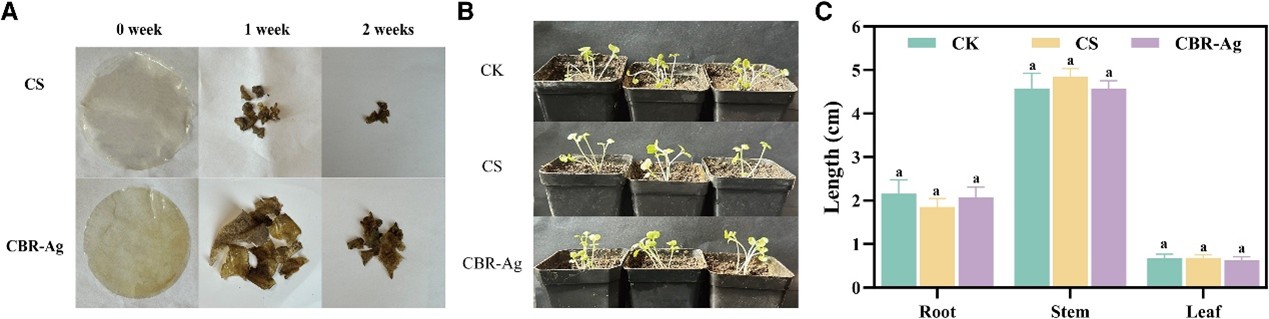
The team prepared extracts from rapeseed cake, flowers, stems, and leaves, then used their plant compounds to reduce silver ions and form AgNPs averaging about 60 nanometers. The particles and extracts were blended into CS film-forming solutions and cast into composite films. Microscopy, FT-IR, XRD, and thermal analysis showed smooth, compact matrices with well-dispersed silver and no large crystalline aggregates. The researchers also measured tensile behavior, water resistance, light transmission, gas barriers, radical scavenging, bacterial inhibition, produce quality, and soil degradation. Compared with pure CS, the rapeseed-cake extract–silver nanoparticle film increased tensile strength from about 8.1 to 17.0 MPa and raised elongation at break from 20.7% to 31.5%. Its water contact angle rose from 55.7° to 87.2°, indicating a less water-attracting surface. The flower-based film delivered the strongest antioxidant performance, reaching 89.7% scavenging in the DPPH assay and 62.3% in the ABTS assay. The rapeseed-cake film inhibited Escherichia coli and Staphylococcus aureus. Coated cherry tomatoes retained more weight, ascorbic acid, and titratable acidity, while packaged enoki mushrooms showed less browning and microbial deterioration. The films fully degraded in soil within 21 days without significantly affecting bok choy growth.
The authors said the central message is that crop residues can do more than replace part of a packaging material: their natural chemistry can help the package actively protect food. By pairing rapeseed phenolics with biosynthesized AgNPs, the team created a film that is stronger, less vulnerable to moisture, and better able to slow oxidation and microbial growth. They said the produce trials are especially important because they move the concept beyond laboratory measurements and show how the material performs on highly perishable foods with different spoilage patterns and preservation needs.
The films could support coatings, wraps, or liners for fresh produce and other foods vulnerable to dehydration, oxidation, browning, and microbial spoilage. Their use could also create new value streams for rapeseed-processing residues while reducing dependence on persistent plastics. However, translation to commercial packaging will require scalable manufacturing, cost and sensory assessments, standardized food-contact testing, and trials under realistic transport and storage conditions. EDS found no detectable silver on tested tomatoes, but the study describes this as preliminary evidence rather than definitive migration proof. Future work should therefore use quantitative methods such as ICP-MS, assess long-term exposure, and evaluate degradation across diverse real-world environments.
References
DOI
10.1093/fqsafe/fyag032
Original Source URL
https://doi.org/10.1093/fqsafe/fyag032
Funding information
Basic Scientific Research Fund of Liaoning Provincial Education Department, China, Nos. LJ212410152045, LJ212510152019, and LJ212510152028
General Project of China Postdoctoral Science Foundation, No. 2024MD763929.
Lucy Wang
BioDesign Research
email us here
Legal Disclaimer:
EIN Presswire provides this news content “as is” without warranty of any kind. We do not accept any responsibility or liability
for the accuracy, content, images, videos, licenses, completeness, legality, or reliability of the information contained in this
article. If you have any complaints or copyright issues related to this article, kindly contact the author above.

Media gallery