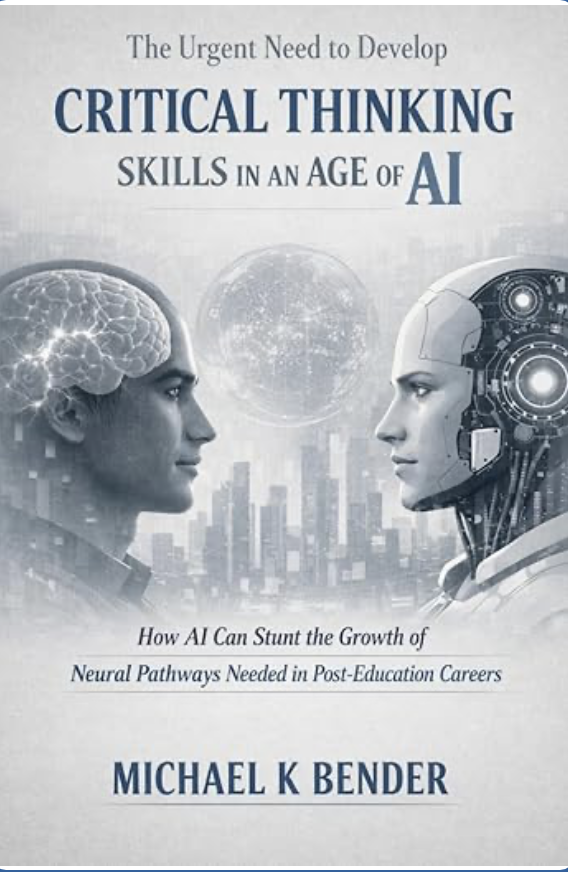
Author Presents Neuroscience-Based Evidence That AI Dependency Creates Learned Helplessness and Threatens Intellectual Development During Critical Development
CAIRO, NY, UNITED STATES, June 2, 2026 /EINPresswire.com/ — A new book, “Neural Pathways, Not Prompts: Why Authentic Literacy Education Cannot Be Outsourced to AI”, presents a critical argument against the growing trend of students using artificial intelligence to bypass authentic learning. The work demonstrates that outsourcing cognitive work to AI during formative educational years creates permanent neurological consequences, eroding the neural pathways essential for independent judgment, authentic voice, and professional expertise.
The Neuroscience of Literacy Development
The book explains that cognitive struggle in reading and writing is not an obstacle to overcome but a neurological necessity. Real thinking develops through productive struggle over years of practice, building the neural pathways required for independent thought. When students eliminate friction by outsourcing to AI, this essential development does not occur. The author emphasizes that literacy education builds cumulatively from kindergarten through college, with each stage dependent on previous cognitive development. Critical developmental periods may close permanently when students bypass this work.
AI’s Fundamental Limitations
While acknowledging artificial intelligence’s impressive ability to summarize information and generate sophisticated prose, the author demonstrates that AI fundamentally lacks the capacity for consciousness, lived experience, and genuine understanding. “AI cannot understand meaning grounded in lived experience,” the author explains. “It recognizes that ‘justice,’ ‘bureaucracy,’ and ‘powerlessness’ co-occur in discussions of Kafka, but it doesn’t understand what powerlessness “feels like”. These aren’t features AI will eventually acquire—they’re capacities only conscious beings possess.”
The Real-World Consequences
Outsourcing creates learned helplessness—a self-fulfilling belief that prevents intellectual growth and leaves students without the intellectual agency needed to navigate a complex adult world.
Concrete Pedagogical Solutions
Rather than calling for an AI ban, the author offers solutions grounded in neuroscience and classroom practice. Educators must prioritize what AI cannot do and value the thinking process, not just polished products. AI can be used strategically—after independent thinking or for comparison and evaluation—but only after students have engaged in genuine cognitive work.
An Urgent Call to Action
The crisis is happening now, during critical developmental periods. Students currently in school are missing irreplaceable windows for neural development. However, recovery is possible. The author calls on educators to protect productive struggle and expect original thinking; parents to understand that intellectual difficulty is productive; and school leaders and policymakers to create structures that protect time for deep intellectual work.
“The choice is ours,” the author states. “We can allow AI to outsource thinking and produce a generation of intellectually dependent adults, or we can protect the conditions where authentic thinking, real writing, and intellectual agency flourish. Teachers across the country are already protecting productive struggle and helping students develop genuine intellectual capacity. The work is difficult but essential—it’s how we ensure the next generation develops capacity for independent thought and meaningful participation in democracy.”
“Neural Pathways, Not Prompts: How AI Can Stunt the Growth of Neural Pathways Needed in Post-Education Careers” is available now at <https://www.amazon.com/dp/B0H2VQ4CN1> and other online retailers.
Media Contact:
michael@mkbender.com
Michael Bender
Michael K Bender
+1 518-704-1688
email us here
How to Stop Learned Helplessness
Legal Disclaimer:
EIN Presswire provides this news content “as is” without warranty of any kind. We do not accept any responsibility or liability
for the accuracy, content, images, videos, licenses, completeness, legality, or reliability of the information contained in this
article. If you have any complaints or copyright issues related to this article, kindly contact the author above.

Media gallery