New Classification System of Malocclusions Published in the Journal of Aligner Orthodontics (JAO) by Prof. Gang Shen’s Team
PR Newswire
SHANGHAI, April 30, 2026
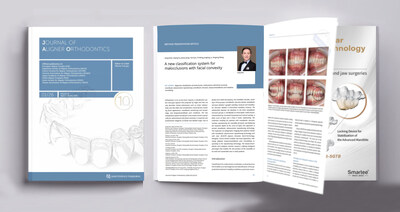
SHANGHAI, April 30, 2026 /PRNewswire/ — A seminal research paper titled “A New Classification System for Malocclusions with Facial Convexity” has been officially published in the 2026 Volume 1 issue of the Journal of Aligner Orthodontics (JAO). This article, authored by Professor Gang Shen and his orthodontic team, introduces a transformative diagnostic framework. Building upon the traditional Angle classification system categorizes and refines the clinical classification of malocclusions with additional diagnostic elements such as mandibular position and morphology, depth of curve of Spee and TMJ status, enabling more precise diagnostics and empowering clinicians to develop optimized treatment strategies.
Professor Gang Shen, the lead author of the paper, serves as the Chief Scientist of GS Technology (Mandibular Advancement Repositioning Technology) at Smartee Denti-Technology.
Redefining Diagnosis for Complex Malocclusions
For over a century, the Angle classification system has focused primarily on molar relationships. Professor Shen’s research expands this scope by integrating facial appearance, mandibular position and morphology, depth of curve of Spee, and temporomandibular joint (TMJ) health into a comprehensive diagnostic system.
In the article, Professor Shen’s team investigates the etiopathogenic mechanisms underlying distinct facial convexity subtypes and proposes evidence-informed, and subtype-specific treatment strategies. The research focuses on the clinical indications, biomechanical principles, and standardized operational protocols of mandibular advancement technology.
The paper explicitly states that leveling the occlusal curve is a critical prerequisite for achieving the desired mandibular repositioning effect. Furthermore, the paper emphasizes that the necessity of tooth extraction should be scientifically evaluated based on refined diagnostic classification, providing clinicians with a robust, evidence-based framework for clinical decision-making.
A New Perspective: Mandibular Morphology Analysis and Risk Assessment
A significant innovation presented in the study is “Mandibular Morphology Analysis,” a diagnostic perspective with substantial clinical implications. By systematically evaluating the overall contour of the mandibular body and the degree of symphyseal concavity through lateral cephalograms, the research identifies two primary mandibular morphologies:
- Flat-Rectangular Mandible: Frequently observed in dentoalveolar facial convexity or cases involving mandibular retrusion. These patients typically present a “three-depth” bite pattern (deep overbite, deep overjet, and deep curve of Spee) and are considered ideal candidates for mandibular advancement therapy.
- Thick-Triangular Mandible: Common in skeletal facial convexity. This morphology is often associated with higher susceptibility of the temporomandibular joint (TMJ), where condylar resorption and mandibular retrusion are more frequently observed.
Theoretical Foundation for GS Technology and S8-SGTB
The classification system serves as the foundation and rationale for Mandibular Advancement Repositioning Technology (MART). As the digital implementation of this clinical wisdom, Smartee’s GS product line provides standardized solutions for complex jaw discrepancies. The S8-SGTB, a specialized appliance within the GS product line mentioned in the research, is designed specifically for treating facial convexity with “three-depth” bite pattern.
Radiographic follow-up data in the study indicate that MART, when implemented via systems such as the S8-SGTB, can facilitate adaptive TMJ remodeling. This provides a viable, non-surgical alternative for achieving sustainable mandibular repositioning even in adult patients.
“This classification system bridges the gap between initial diagnosis, treatment planning, and long-term clinical outcomes,” said Professor Gang Shen. “By identifying specific mandibular morphologies, practitioners can make more informed decisions between conventional extraction therapies and mandibular advancement repositioning.”
About Smartee Denti-Technology
Founded in 2004, Smartee is the leading provider of clear aligners and digital orthodontic solutions in China. Headquartered in Shanghai, Smartee has four research & development centers and four manufacturing bases in China and Spain. By serving over 99,000 doctors in over 57 countries, Smartee has launched over 10 aligner products catering to different malocclusion problems for children, adolescents and adults.
 View original content to download multimedia:https://www.prnewswire.com/news-releases/new-classification-system-of-malocclusions-published-in-the-journal-of-aligner-orthodontics-jao-by-prof-gang-shens-team-302758332.html
SOURCE Smartee Denti-Technology