
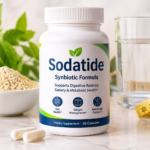
The ingredient-focused review outlines the supplement’s disclosed quantities of chicory root inulin, potato resistant starch and a three-species probiotic blend while examining the limits of existing human research.
The ingredient-focused review outlines the supplement’s disclosed quantities of chicory root inulin, potato resistant starch and a three-species probiotic blend while examining the limits of existing human research.
LAKELAND, Fla., November 15, 2026 — Sodatide has published an ingredient-focused review examining the three-component formula in its daily dietary supplement, outlining the amounts disclosed on its Supplement Facts panel and reviewing published research on prebiotic fibers and probiotic microorganisms.
The review examines three listed components: 211 milligrams (mg) of chicory root inulin, 100 mg of potato resistant starch and a 36 mg probiotic blend containing Bifidobacterium infantis, Clostridium butyricum and Akkermansia muciniphila. It also distinguishes research conducted on individual ingredients from clinical evidence evaluating the finished Sodatide formula.
The publication addresses an important distinction in supplement research: evidence that an ingredient has been studied in humans does not automatically establish that a particular commercial product produces the same results. Study doses, bacterial strains, product composition and research methods all influence how findings should be interpreted.
What does the Sodatide review examine?
The review examines the product’s three disclosed active components, their listed quantities and the scientific literature concerning prebiotic fibers and probiotic microorganisms. It does not present ingredient research as proof of the finished formula’s effectiveness.
According to the product’s published Supplement Facts information, Sodatide provides one capsule per serving and 30 servings per container. The label identifies two fiber ingredients and one combined probiotic blend.
The formula’s declared active ingredients total 347 mg per capsule. The probiotic blend accounts for 36 mg of that amount, but the label does not specify how much of the blend belongs to each named microorganism.
The review also identifies information that consumers cannot determine from the label alone, including the individual quantity of each probiotic species, the colony-forming unit (CFU) count and the specific strain identifiers.
These details matter because the weight of a probiotic powder does not establish how many viable microorganisms it contains. Likewise, naming a bacterial species does not establish that every strain within that species has the same documented effects.
See what makes Sodatide’s ingredient blend interesting.
What ingredients are listed in Sodatide?
Sodatide lists two prebiotic fiber ingredients and one probiotic blend. The product label provides a separate quantity for each listed component, although it does not disclose individual quantities or CFU information for the three microorganisms.
|
Listed ingredient |
Amount per capsule |
|---|---|
|
Chicory root inulin |
211 mg |
|
Potato resistant starch |
100 mg |
|
Probiotic blend |
36 mg |
|
Total active ingredients |
347 mg |
The three microorganisms named within the probiotic blend are Bifidobacterium infantis, Clostridium butyricum and Akkermansia muciniphila.
The other ingredients listed in the product information include hypromellose, microcrystalline cellulose, magnesium stearate and silica. These are separate from the three active components and should not be counted as additional probiotic strains or prebiotic ingredients.
What the Formulator Says About Sodatide’s Formula
“An important part of evaluating a multi-ingredient supplement is understanding not only which ingredients are included, but also how their individual amounts compare with those examined in published research,” said Dr Peter at Sodatide. “Our ingredient review is intended to present the formulation details clearly while distinguishing between research conducted on individual ingredients and clinical evidence for the finished product. Those distinctions are important when interpreting what a supplement label can and cannot establish.”
What does research say about chicory root inulin?
Chicory root inulin is a soluble dietary fiber that can be fermented by microorganisms in the large intestine. Human research has examined its relationship with gut microbial composition, particularly the abundance of Bifidobacterium.
A systematic review and meta-analysis published in 2022 examined randomized controlled trials involving chicory-derived inulin-type fructans. Across 50 studies involving 2,525 participants, researchers reported a significant increase in Bifidobacterium abundance at daily intake levels generally ranging from 3 to 20 grams.
The review also reported findings related to bowel function in healthy participants. However, the studies varied in their populations, supplementation periods and outcomes.
The amount listed in Sodatide is 211 mg, equivalent to 0.211 grams per capsule. This is substantially below the daily quantities examined in the cited research. Consequently, the findings cannot establish that Sodatide produces the same microbiome changes observed in those trials.
Another systematic review published in the British Journal of Nutrition examined human studies of inulin supplementation and gut microbial composition. Researchers found that an increase in Bifidobacterium was among the more consistent findings, while other microbial changes varied between studies.
The review also noted that changes in bacterial composition did not consistently establish corresponding increases in short-chain fatty acids.
These findings provide context for why inulin is studied as a prebiotic fiber, but they do not demonstrate a specific clinical outcome from the quantity contained in Sodatide.
What has research found about potato resistant starch?
Potato resistant starch is a type of starch that resists digestion in the small intestine and can reach the large intestine, where intestinal microorganisms ferment it. Researchers have examined its effects on microbial composition, bowel function and the production of fermentation-related compounds.
A randomized, double-blind, placebo-controlled clinical trial published in 2023 evaluated resistant potato starch at daily amounts of 3.5 grams and 7 grams over four weeks. The researchers reported changes in the relative abundance of certain gut bacteria, including Bifidobacterium and Akkermansia, in participants receiving the 3.5-gram amount.
The study also examined bowel movement patterns and reported differences in some outcomes compared with placebo.
The findings are relevant to research on resistant starch as a prebiotic ingredient. However, the study investigated a specific resistant potato starch preparation at quantities considerably higher than the 100 mg listed in Sodatide.
A separate 2024 analysis examined data from a randomized clinical trial involving 3.5-gram and 7-gram daily doses of resistant potato starch. The analysis explored relationships between changes in gut microbiota and reported gastrointestinal symptoms. Its findings were exploratory and did not establish that resistant starch reliably improves every symptom or produces the same response in all individuals.
The distinction in dosage is important. Sodatide’s listed 100 mg amount equals 0.1 grams per capsule. The cited 3.5-gram research dose is 35 times higher.
Accordingly, existing research on resistant potato starch should be interpreted as ingredient-level evidence rather than direct clinical evidence for Sodatide.
What is known about the three probiotic microorganisms?
The Sodatide label identifies three microorganisms in a combined 36 mg probiotic blend. Research on probiotics shows that effects can depend on the specific strain, viable count, formulation and population studied.
Bifidobacterium infantis is a name used for a group of bacteria associated with the human intestinal microbiome. Some human studies have investigated particular strains, including research involving infants. Results from one identified strain and population cannot automatically be applied to another strain or to adults using a different formulation.
Clostridium butyricum has been studied for its role in intestinal microbial activity and the production of butyrate. However, findings from specific preparations or strains do not establish the effects of every product listing the species.
Akkermansia muciniphila is a microorganism that has attracted research interest because of its relationship with the intestinal mucus layer and metabolic processes. Human and laboratory research has examined particular preparations, but the evidence remains formulation-specific.
The National Institutes of Health Office of Dietary Supplements explains that probiotic effects can be species-specific and strain-specific. This makes strain identification important when interpreting research or comparing probiotic products.
For Sodatide, the published label names the three species but does not provide strain codes, individual quantities or a CFU count. Without those details, it is not possible to establish whether the product contains the same strains or viable doses used in particular clinical trials.
Does research prove that Sodatide supports weight loss or appetite control?
No conclusion about weight loss or appetite control can be drawn from the ingredient list alone. Research on individual fibers and microorganisms does not establish that the finished Sodatide formula produces a measurable weight-management outcome.
Some studies have examined how dietary fiber affects fullness, food intake and digestive processes. Other research has explored relationships between gut microorganisms and metabolic markers. However, these are different research questions, and results depend on the ingredients, doses, study design and participants.
The published Sodatide label lists 211 mg of inulin, 100 mg of resistant starch and a 36 mg probiotic blend. The available information does not establish that the finished product has undergone a randomized controlled clinical trial demonstrating weight loss, appetite reduction or a specific metabolic effect.
For that reason, claims about the product’s finished-formula effectiveness should not be based solely on studies of its individual ingredients.
Curious about Sodatide’s ingredient combination? Explore more.
Why do ingredient quantities and probiotic details matter?
Ingredient quantities help readers compare a product’s formula with amounts examined in published research. Probiotic strain identifiers and CFU information provide additional context for evaluating the microorganisms in a formulation.
Sodatide discloses the total weight of its three active components and names the microorganisms in its probiotic blend. However, the label does not provide the individual quantity or viable count of each microorganism.
This does not, by itself, establish that the formula is ineffective or unsafe. It identifies a limitation in the information available for comparing the blend with specific probiotic studies.
A complete clinical evaluation of the finished formula would require research using the actual product, its intended serving and a clearly defined study population.
How should consumers interpret dietary supplement research?
Consumers should distinguish between an ingredient’s scientific history and evidence for a particular finished product. A study involving several grams of a fiber or a specific probiotic strain may not apply to a capsule containing a smaller quantity or a different microorganism preparation.
The review also considers the importance of reading the complete Supplement Facts panel, directions and caution statements rather than relying only on general descriptions of gut health or metabolic support.
The National Institutes of Health and the National Center for Complementary and Integrative Health both provide educational resources explaining that probiotic research varies by strain, intended use and population. They also note that evidence supporting one application does not necessarily support other uses.
Consumers considering a probiotic supplement should consult a qualified healthcare professional when they have an underlying medical condition, are taking medication or have concerns about possible interactions or suitability.
What are the product’s serving directions and label details?
The published Sodatide label lists a serving size of one capsule and 30 servings per container. Its suggested use is one capsule daily with an eight-ounce glass of water.
The product information identifies a vegetarian hypromellose capsule and lists microcrystalline cellulose, magnesium stearate and silica among the other ingredients. The label also advises consumers to follow its stated cautions and not exceed the recommended serving.
The product’s published label identifies Instituto Experience in Lakeland, Florida, as its distributor and describes the product as made in the United States with globally sourced ingredients. These details should be checked against the physical packaging and current company records before publication.
Explore what makes Sodatide’s formula unique.
Frequently Asked Questions
What are the main ingredients in Sodatide?
Sodatide lists chicory root inulin at 211 mg, potato resistant starch at 100 mg and a 36 mg probiotic blend containing Bifidobacterium infantis, Clostridium butyricum and Akkermansia muciniphila per capsule.
How many probiotic strains are listed in Sodatide?
The label names three probiotic species. It does not provide individual strain codes, the amount of each microorganism or a CFU count.
Is Sodatide clinically proven to cause weight loss?
The ingredient information and published ingredient research do not establish that the finished Sodatide formula causes weight loss. Product-specific clinical evidence would be needed to support such a conclusion.
What is the difference between a prebiotic and a probiotic?
A prebiotic is a substance, often a type of fiber, that can be used by microorganisms in the body. A probiotic is a live microorganism that may provide a health benefit when administered in adequate amounts and under appropriate conditions.
Does Sodatide contain inulin?
Yes. Its Supplement Facts information lists 211 mg of chicory root inulin per capsule.
Does Sodatide contain resistant starch?
Yes. The product label lists 100 mg of potato resistant starch per capsule.
Has the FDA approved Sodatide?
Dietary supplements are not approved by the FDA for safety and effectiveness before they are marketed in the same way as prescription drugs. Consumers should not interpret a supplement’s availability or label claims as FDA approval.
Can ingredient research confirm the effectiveness of the complete formula?
No. Ingredient-level research provides scientific context, but a clinical trial evaluating the finished formula is needed to determine whether the complete product produces a particular outcome.
Product guide: Sodatide Official Website
About Sodatide
Sodatide is a dietary supplement marketed in capsule form. Its published Supplement Facts information identifies chicory root inulin, potato resistant starch and a three-species probiotic blend. Additional company background, founding year, corporate mission and product-range information should be supplied and approved by the company before publication.
Media Contact
Media Contact: Kevin
Title: Media Relations Manager
Brand: Sodatide
Email: support@customercs.com
Location: 824 Florida 13, Lakeland, FL 33109, USA
Product Information: Sodatide.com


